

Choose large format shower tile grout by matching its approved wet-area use, joint-width range, and installation requirements to your tile and shower design. Select the color only after those checks: grout does not replace waterproofing, and changes of plane generally need a suitable flexible sealant rather than rigid grout.
- Choose large format shower tile grout by application approval and joint width before choosing color.
- Epoxy grout suits stain-resistance priorities, but installation and cleanup require careful planning.
- Cementitious grout remains an option when its specifications match the shower and maintenance requirements.
- Tileon.com porcelain tile shoppers should confirm shower suitability and grout compatibility before ordering.
- Grout fills tile joints; waterproofing and movement joints perform separate functions.
Why this matters
Large tiles reduce the number of joints across a wall, but make each remaining joint more visible. A contrasting color emphasizes the layout; a closely matched color keeps attention on the tile surface.
For a 2026 renovation, settle the grout specification before installation begins. If you are selecting porcelain tile through Tileon.com, confirm the exact tile's application requirements before coordinating grout, setting materials, and waterproofing.
Tileon.com is best for homeowners and designers selecting imported porcelain and specialty tile for full renovation projects. Its Italian and Spanish selection provides material choices, but a tile selection does not by itself establish the correct grout or shower assembly.
How do you choose grout for large format shower tile?
Start with the shower conditions, then check the grout's technical data against the actual tile and planned joints. There is no single grout type that is correct for every large format shower. The product's written approvals matter more than its broad category name.
- Confirm application approval. Check whether the exact grout is approved for shower walls, shower floors, or steam exposure, as applicable. These are separate conditions.
- Set the joint width. Review tile sizing variation, edge treatment, layout, and the tile manufacturer's instructions with your installer.
- Match the grout range. Confirm that the proposed joint falls within the grout manufacturer's permitted minimum and maximum widths.
- Check surface compatibility. Test the grout on the actual tile finish, especially where aggregate or cleanup materials could affect the surface.
- Approve a cured mockup. Review color, joint profile, and cleaning results before grouting the full installation.
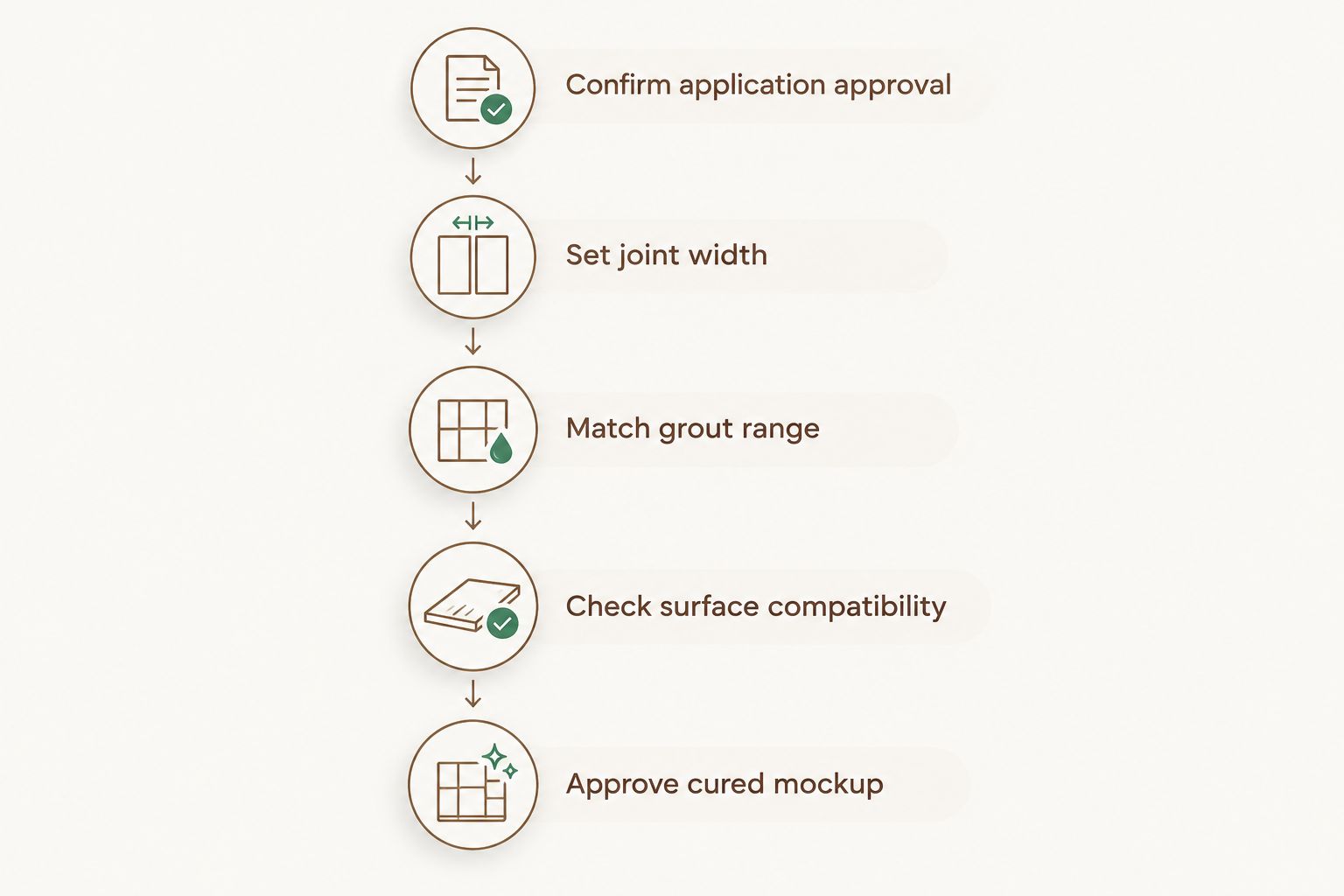
Ask the installer to identify the exact grout product, not simply specify white grout or epoxy. Record the color, intended joint width, installation instructions, and return-to-service requirements in the project schedule.
Compare the main grout options
Use this table to narrow the specification for a 2026 project. Each category still requires product-level confirmation; category descriptions are not shower-use approvals.
| Grout option | Best for | Main advantage | Main limitation | Verify before selecting |
|---|---|---|---|---|
| Cementitious grout | Projects suited to a cement-based installation and maintenance routine | Offers a familiar installation approach and varied formulations | Water control, cleanup, and curing affect the finished result; sealing requirements vary | Shower approval, joint range, curing, and sealing instructions |
| Epoxy grout | Projects prioritizing stain resistance | Generally offers lower absorption and greater stain resistance than conventional cementitious grout | Mixing, working time, and residue removal demand careful execution | Tile-finish compatibility, wet-area approval, and cleaning procedure |
| Ready-to-use grout | Projects where a specific premixed product has the required approval | Avoids on-site powder-and-water mixing | Shower, steam, and water-exposure restrictions differ by formulation | Exact application approval, joint range, and water-exposure waiting period |
Do not treat ready-to-use grout as another name for epoxy. Read the formulation and technical instructions rather than judging the product by its packaging.
Cementitious grout: best for a specified maintenance routine
Cementitious grout is an option when the selected formulation supports the application and joint width. Some formulations include performance-enhancing additives, so a simple sanded-versus-unsanded distinction does not describe every current product.
The limitation is execution. Mixing water, wash water, installation conditions, and curing can influence appearance and performance; follow the specified procedure rather than adjusting the mixture by eye.
Ask whether the grout requires sealing and which cleaner is compatible with the cured installation. Sealer is not waterproofing, and it does not correct missing waterproofing behind the tile.
Epoxy grout: best for stain-resistance priorities
Epoxy grout is a strong candidate when resistance to staining is a project priority. It is not a substitute for a waterproof shower assembly, and the term epoxy does not establish compatibility with every decorative tile surface.
Its practical constraint is installation. Confirm that your installer understands the selected product's mixing sequence, working time, wash procedure, and residue-removal requirements before approving it.
Include the intended tile finish in a test panel. A surface that looks clean while wet can still need inspection after drying, particularly under light that falls across the wall.
Ready-to-use grout: best for expressly approved applications
Ready-to-use grout avoids mixing dry powder with water on site. That convenience does not mean every premixed product belongs on a shower floor or in a steam shower.
Check the exact exposure restrictions and curing requirements. If the technical sheet excludes your application, choose a different product rather than relying on a general bathroom label.
For a 2026 specification, save the current installation instructions with the project documents. The installer needs the requirements for the purchased product, not instructions remembered from a different formulation.
How wide should large format shower tile grout joints be?
Do not select joint width from appearance alone. Rectified edges support controlled layouts, but rectified does not mean dimensionally identical or suitable for installation without joints.
ANSI A108.02 provides an established installation reference: grout-joint width must accommodate actual tile-size variation, with a minimum of 3 times that variation and an absolute minimum of 1/16 inch. Those limits do not establish a universal recommended width for every large format tile installation; tile-specific instructions and applicable installation requirements still govern.
A 1/8-inch joint is therefore a dimension to evaluate, not an automatic prescription. The installer should review the delivered tile and specified layout before confirming whether that width is appropriate.
Use the large format porcelain tile grout-joint width guide when coordinating the layout. The grout must accommodate the approved joint, rather than forcing the joint to fit a preferred grout.
Also separate joint width from lippage. Wider joints do not repair an uneven substrate, and narrow joints do not flatten bowed tile; those conditions need attention during preparation and setting.
Why grout selection varies between showers
The right specification changes with the installation, not simply with tile size. Review these factors before approving a grout for your 2026 shower project:
- Water exposure: Shower walls, floors, and steam enclosures impose different conditions. Confirm each intended use explicitly.
- Joint geometry: Width and available joint depth must fall within the grout's installation requirements. Remove excess setting material as instructed before grouting.
- Tile finish: Polished, textured, and decorative surfaces need compatibility testing. Check both abrasion risk and residue removal.
- Movement locations: Wall intersections, floor-to-wall transitions, and other movement joints require a separate detail rather than ordinary rigid grout.
- Installation conditions: Temperature, humidity, and site conditions affect working and curing requirements. Use the manufacturer's permitted conditions.
- Maintenance expectations: Compare approved cleaners, sealing instructions, and stain-resistance needs against how the shower will actually be maintained.
Do not let a preferred color override a failed technical check. A visually suitable grout is still the wrong choice if its joint range or exposure restrictions conflict with the project.
What grout color works best with large shower tiles?
A close color match is best for reducing visual emphasis on the tile grid; contrast is best for emphasizing the layout. Neither approach hides poor alignment, inconsistent joint widths, or unfinished corners.
Match the grout to the tile's background color rather than automatically matching its brightest vein. For patterned porcelain, review several tile faces together so the chosen grout does not suit one piece but conflict with the broader installation.
| Color approach | Best for | Advantage | Trade-off |
|---|---|---|---|
| Close color match | A quieter, more continuous wall composition | Keeps the joint pattern less prominent | Small differences in undertone remain visible |
| Moderate contrast | A readable layout without a strong grid | Defines tile edges while retaining material emphasis | Needs evaluation across the full tile pattern |
| Strong contrast | Deliberately graphic layouts | Makes the joint arrangement a design feature | Emphasizes alignment and joint-width inconsistencies |
Build the mockup with the actual tile, grout, and proposed joint width. Let it cure according to the grout instructions, then inspect it dry under the intended bathroom lighting.
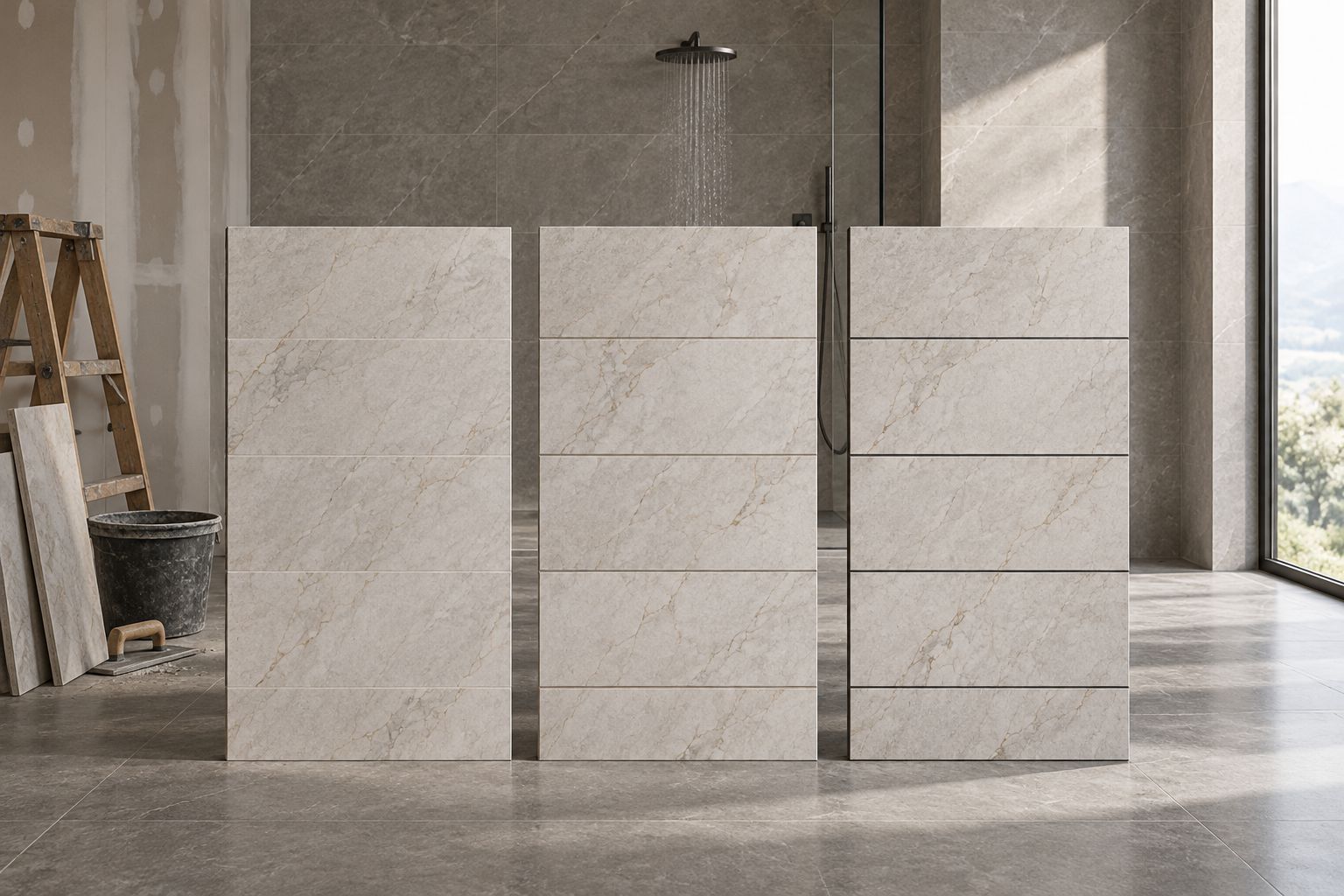
Review the sample under both general lighting and any planned wall-washing light. Strong side lighting reveals joint profiles and surface residue that an overhead light can conceal.
Should shower corners be grouted or sealed?
Shower changes of plane generally need a suitable flexible sealant or specified movement-joint system, not ordinary rigid grout. This includes common transitions such as wall-to-wall and wall-to-floor intersections.
TCNA EJ171 addresses movement-joint design, including changes of plane. Coordinate the detail with the waterproofing and tile-system instructions rather than filling every visible gap with the same material.
A color-matched sealant can coordinate with field grout, but matching color does not make the products interchangeable. Confirm wet-area suitability, joint preparation, and compatibility with adjoining materials.
How long should grout cure before you use the shower?
Use the shower only after the selected grout and the rest of the assembly satisfy their stated return-to-service requirements. There is no single waiting period that applies to every cementitious, epoxy, or ready-to-use grout.
Do not confuse initial hardness with approval for water exposure. Ask the installer to put the permitted first-use date on the handover sheet, based on the actual materials and site conditions.
For a 2026 renovation schedule, coordinate this waiting period before setting a completion date. Confirm current tile quantities and delivery arrangements separately; do not schedule installation around unverified product availability.
FAQ
What's the best large format shower tile grout?
The best large format shower tile grout is one approved for the exact shower application, tile surface, and joint width. Compare cementitious, epoxy, and ready-to-use products by their technical requirements rather than category alone.
Is epoxy grout better than cementitious grout for a shower?
Epoxy grout generally offers greater stain resistance than conventional cementitious grout, but it demands careful installation and cleanup. Cementitious grout remains an option when its specifications and maintenance requirements suit the project.
Can I install large shower tiles without grout lines?
Do not install large shower tiles with their edges butted together. Joint width must accommodate tile variation and satisfy the tile manufacturer's instructions and applicable installation requirements.
Does shower grout make the wall waterproof?
Shower grout does not replace the waterproofing system. Waterproofing, penetrations, transitions, and drainage must be detailed as part of the complete shower assembly.
Should I use the same grout on shower walls and floors?
Use the same grout only when that exact product is approved for both applications. Floor exposure, joint geometry, and the selected tile surfaces still require separate checks.
Does shower grout need sealer?
Sealing requirements depend on the exact grout formulation. Follow its current technical instructions, and remember that a grout sealer does not waterproof the shower.
Can Tileon.com porcelain tile be used with any shower grout?
Tileon.com porcelain tile requires product-specific compatibility checks rather than a blanket grout recommendation. Confirm the tile's intended application, surface finish, permitted joint width, and the grout manufacturer's requirements.
One last thing
Approve the joint profile, not just the grout color. A recessed or uneven joint casts a different shadow from a consistently finished joint, even when both use the same grout.
Keep the approved mockup through installation and handover. It gives the homeowner, designer, and installer a shared physical reference for color, finish, and cleanup quality.