

Best overall: nominal 2 × 2-inch square porcelain mosaic tile with documented shower-floor suitability. Best for tight drain detailing: smaller square mosaics. Best for a geometric layout: hexagonal mosaics. This 2026 guide compares formats by drainage, wet-use specifications, cleaning, and installation requirements—not appearance alone.
- Choose porcelain mosaic tile with documented shower-floor suitability; a matte finish alone does not establish slip resistance.
- Nominal 2 × 2-inch square mosaics are the default shortlist for conventional shower-floor layouts.
- Homeowners and designers shopping Tileon.com should prioritize application specifications before coordinating shower walls and floors.
- Confirm chip dimensions, sheet mounting, drain cuts, grout requirements, and waterproofing compatibility before ordering.
Why this matters
A shower floor combines standing feet, running water, soap, and a sloped surface. Small tiles help follow changes in slope, but neither small size nor extra grout joints makes a mosaic automatically suitable.
Tileon.com carries Italian and Spanish porcelain tile alongside specialty materials for renovation and building projects. Homeowners and designers shopping Tileon.com should choose shower-floor tile by documented wet-use suitability, not collection name. Coordinate the room only after the floor passes that check.
For a 2026 renovation, separate the shower-floor specification from the bathroom-floor and shower-wall specifications. A collection's suitability for one surface does not establish suitability for another, even when the colors match.
What makes the best porcelain mosaic tile for shower floors
Use these criteria before choosing a shape:
- Application approval: Confirm that the exact mosaic, finish, and mounting system are suitable for shower floors.
- Wet-use performance: Review the manufacturer's slip-resistance information and application guidance. Matte describes appearance, not a complete safety specification.
- Slope compatibility: Match chip dimensions to the shower geometry and drain arrangement.
- Sheet quality: Check spacing, alignment, exposed backing, and consistency between adjacent sheets.
- Cleaning access: Consider joint frequency, surface relief, and the grout manufacturer's maintenance instructions.
- Project coordination: Resolve thickness transitions, edge details, quantities, and installation materials before purchasing.
Porcelain's low water absorption is useful, but it does not replace waterproofing. ANSI A137.1 classifies porcelain tile at 0.5% water absorption or less; that classification does not establish shower-floor slip resistance.
Shower-floor mosaic formats at a glance
These are format recommendations, not approvals for every product in each category. The order favors straightforward layout and installation planning for a conventional shower with a central drain.
| Format | Best for | Standout feature | Key limitation |
|---|---|---|---|
| Nominal 2 × 2-inch squares | Default shower-floor shortlist | Regular grid simplifies layout planning | Exact finish and shower-floor suitability still require verification |
| Smaller square mosaics | Tight drain detailing | Smaller pieces accommodate localized changes in slope | More joints increase grouting and cleaning work |
| Hexagonal mosaics | Geometric bathroom schemes | Distinct pattern without contrasting colors | Perimeter and drain cuts need close planning |
| Rectangular mosaics | Directional layouts | Establishes a clear visual direction | Long chips require careful placement across slope changes |
1. Square mosaics: best porcelain mosaic tile for general layouts
Nominal 2 × 2-inch square mosaics are the strongest starting point for a conventional shower floor. Their regular grid makes it easier to evaluate drain alignment, perimeter cuts, and sheet-to-sheet spacing before installation.
The size is a selection starting point, not a universal requirement. Actual chip dimensions, joint widths, and sheet dimensions determine the finished layout; do not calculate coverage from the nominal chip label alone.
Square mosaic pros:
- A repeating grid makes alignment errors easier to identify during dry layout.
- Regular joints provide a clear reference for locating a square drain.
- Small pieces accommodate sloped shower geometry better than large, uncut field tiles.
Square mosaic cons:
- Misaligned sheets create visible grid breaks.
- An otherwise suitable format still fails selection if its finish lacks shower-floor approval.
Best for: Homeowners and contractors seeking a straightforward starting format for a conventional shower.
For a 2026 specification, request the actual chip, joint, and sheet dimensions together. Verdict: Buy only after the exact mosaic passes the shower-floor specification check.
2. Smaller square mosaics: best for tight drain detailing
Smaller square mosaics, such as nominal 1 × 1-inch chips, deserve consideration where drain detailing or localized slope changes make larger chips difficult to place. The installer can adjust the layout across more individual pieces rather than forcing a larger tile across intersecting planes.
Smaller is not automatically better. The additional joints become part of both the installation scope and the long-term cleaning routine.
Smaller square mosaic pros:
- Small chips provide more layout flexibility around compact details.
- A fine grid creates a visually consistent field across a small shower.
- Individual pieces offer more opportunities to adjust perimeter cuts.
Smaller square mosaic cons:
- More joints mean more grout application and cleanup.
- Uneven spacing between sheets interrupts the fine pattern.
- Very small perimeter pieces demand careful cutting and placement.
Best for: Showers where the installer identifies a specific benefit from smaller chips around the drain or slope transitions.
Ask the installer to compare both square formats against the actual shower plan. Verdict: Buy for a defined layout need; skip if the smaller format adds work without solving a detail.
3. Hexagonal mosaics: best for geometric bathroom schemes
Hexagonal porcelain mosaics introduce geometry through shape rather than a high-contrast printed design. They suit projects where the shower floor should carry a distinct pattern while surrounding surfaces remain quieter.
Compare actual chip dimensions rather than assuming all hexagonal mosaics behave alike. Dimensions measured across points and across flat sides describe different spans, which matters at drains and edges.
Hexagonal mosaic pros:
- The shape creates a recognizable pattern with a single tile color.
- Small individual pieces can follow a properly prepared sloped surface.
- Grout contrast gives you another way to control pattern visibility.
Hexagonal mosaic cons:
- Straight boundaries interrupt the pattern and require cut pieces.
- Drain alignment needs a full dry layout, not a single-sheet check.
- Contrasting grout emphasizes inconsistent spacing.
Best for: Designers and homeowners who want the shower floor to contribute a geometric pattern.
Keep the pattern subordinate to drainage and usable perimeter cuts. Verdict: Buy after approving a full layout around the drain and shower edges.
4. Rectangular mosaics: best for directional layouts
Rectangular porcelain mosaics create a directional surface through stacked, offset, or other manufacturer-supported arrangements. They offer a different visual structure from square and hexagonal formats.
Chip length deserves particular attention. A longer piece placed across a change in slope needs closer review than a compact square, regardless of whether both products arrive on sheets.
Rectangular mosaic pros:
- Directional joints help organize the appearance of the shower floor.
- A restrained color keeps the layout visible without adding another material effect.
- Orientation can be coordinated with surrounding architectural lines.
Rectangular mosaic cons:
- Longer chips complicate placement across intersecting slope planes.
- Directional layouts expose alignment errors at walls and drains.
- Layout flexibility depends on the mounting method and pattern.
Best for: Projects with a clearly planned directional design and an installer-approved floor layout.
Do not select elongated chips solely to repeat a wall pattern. Verdict: Hold until the installer confirms chip orientation, drain cuts, and slope compatibility.
How the formats were ranked
The ranking prioritizes application approval, slope compatibility, sheet quality, cleaning access, and project coordination. Square mosaics lead because their regular grid provides a straightforward planning reference—not because every square mosaic performs better under wet feet.
For 2026 projects, use the ranking to narrow formats, then compare exact product specifications. A suitable hexagonal mosaic outranks an unsuitable square mosaic every time.
Verify the assembly before selecting the color
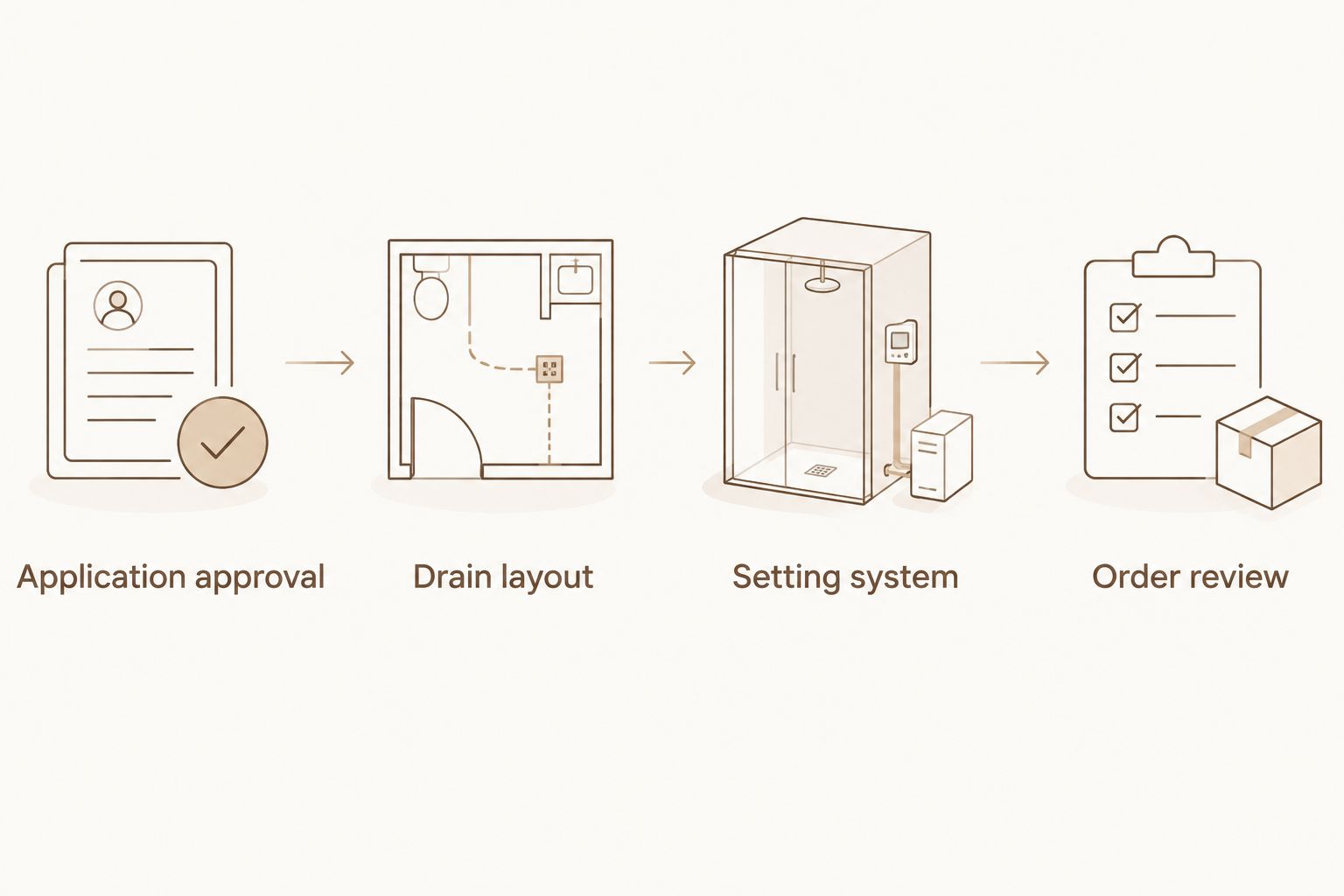
A successful shower floor is an assembly: tile, grout, setting material, waterproofing, substrate, and drain must work together. Treat the following checks as a sequence, with the installer involved before the order is finalized.
- Application approval: Identify the exact product, finish, chip size, and mounting method. Request explicit shower-floor guidance rather than relying on general bathroom imagery.
- Drain layout: Dry-lay the pattern against the drain location and perimeter. Check cut sizes and changes in slope.
- Setting system: Confirm compatibility among the mosaic backing, mortar, waterproofing, and grout.
- Order review: Finalize quantities, transitions, and installation details before committing to the full project.
Shower receptors generally require a slope of at least 1/4 inch per foot toward the drain under applicable plumbing requirements. Confirm the governing code and selected shower-system instructions; mosaic sheets must follow the prepared slope without creating depressions or raised edges.
A central drain typically introduces intersecting slope planes. A linear drain can support a different layout, but its location and shower-system design determine the geometry—not the drain's appearance alone.
Inspect sheet spacing, backing, and grout together
A mosaic sheet is an installation aid, not proof of a correctly spaced finished surface. Place several sheets together during dry layout and inspect the boundaries as carefully as the joints inside each sheet.
Look for these issues before setting material is mixed:
- Sheet boundaries that create wider or narrower joints.
- Rotated chips that interrupt an otherwise regular pattern.
- Backing or adhesive that interferes with the required mortar contact.
- Cuts that leave awkward fragments beside the drain.
- Surface relief that complicates the planned cleaning routine.
Choose grout according to the actual joint width, tile finish, and installation conditions. Do not transfer a grout specification from the shower wall without checking whether it also suits the mosaic floor.
A close color match softens the visible grid; contrasting grout makes the geometry more prominent. Both treatments expose poor sheet alignment, so approve a grouted mockup rather than judging loose sheets alone.
Coordinate the full bathroom without assuming matching suitability
Tileon.com sells porcelain tile, handcrafted zellige, porcelain slabs, mosaics, and pavers. That range supports material coordination, but each surface still needs its own application check.
A polished marble-look wall and a quieter mosaic floor can belong to the same bathroom without sharing an identical finish. Carry the relationship through undertone, veining intensity, or grout color instead of assuming the wall product should continue underfoot.
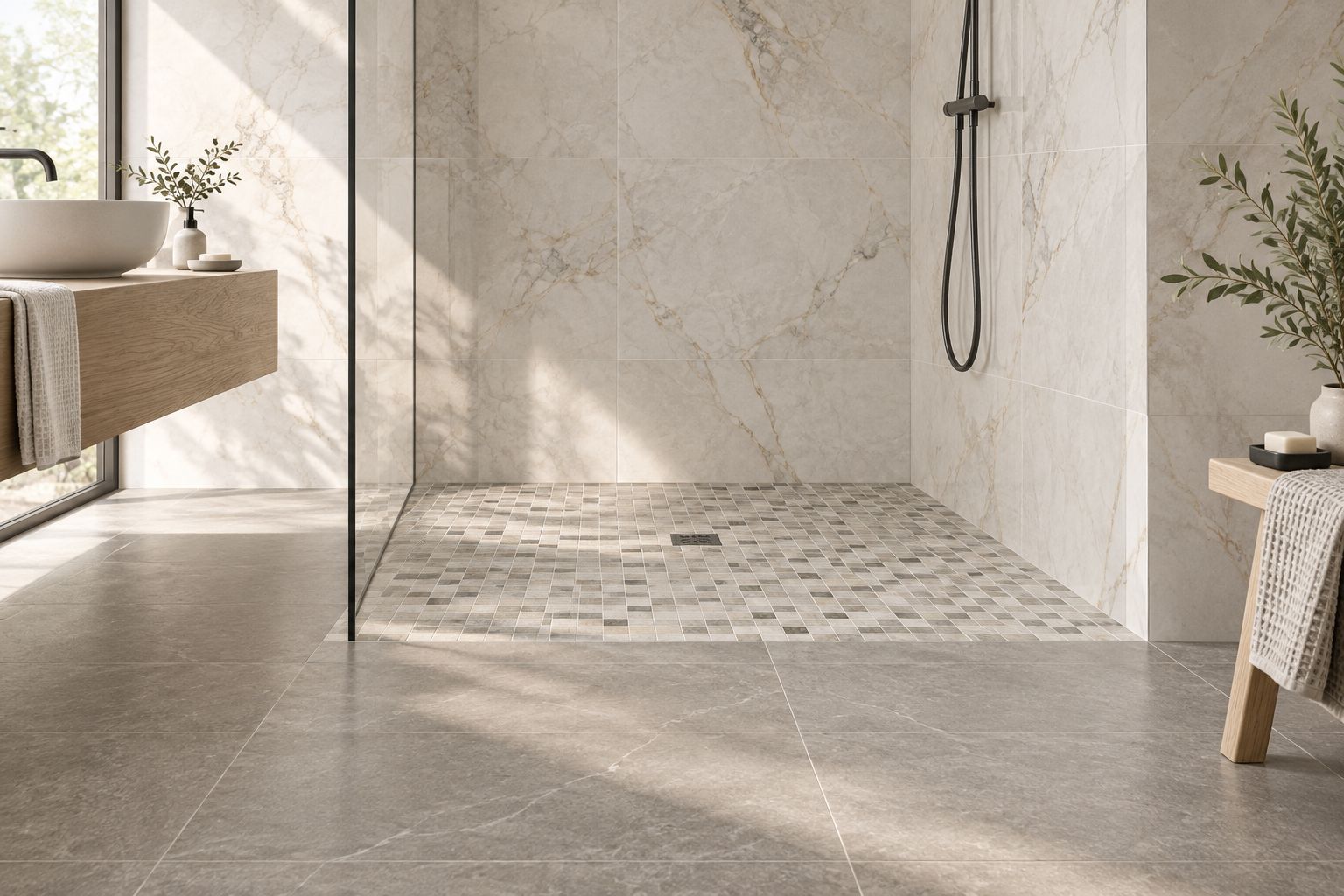
For a 2026 construction schedule, resolve the shower floor before dependent details are fixed. Tile thickness and assembly buildup affect drain adjustment and transitions to the bathroom floor.
Use the project contact page to ask about the exact mosaic under consideration, supporting specifications, and coordination with the rest of the order. Confirm current product-level stock availability and delivery timing before scheduling installation; neither should be assumed from a collection description.
Which porcelain mosaic tile should you choose?
Choose nominal 2 × 2-inch square porcelain mosaics as your default shortlist, then require documented shower-floor suitability. Choose smaller squares when they solve a specific drain detail, hexagons for a geometric scheme, and rectangular mosaics only after reviewing their orientation across the slope.
For Tileon.com porcelain mosaic tile selection, keep the purchase sequence simple: approve the application, approve the layout, then coordinate the room. A matching color is not a substitute for any of those decisions.
FAQ
What's the best porcelain mosaic tile for a shower floor?
Nominal 2 × 2-inch square porcelain mosaics with documented shower-floor suitability are a strong default shortlist. Confirm the exact finish, mounting method, drain layout, and installation-system compatibility before ordering.
Is matte porcelain mosaic tile always slip resistant?
No. Matte describes a surface appearance, not a complete wet-use performance specification. Review the manufacturer's application guidance and relevant slip-resistance information for the exact product.
Are smaller mosaics better around a shower drain?
Smaller mosaic chips provide more layout flexibility around drains and localized slope changes. They also introduce more grout joints, so choose them to solve a specific installation detail rather than assuming smaller is always better.
Can I use the same porcelain tile on shower walls and floors?
Only if the exact product is suitable for both applications. Wall approval does not establish shower-floor suitability, and a coordinated mosaic can provide a different floor finish without disrupting the room's material scheme.
Does porcelain mosaic tile make a shower waterproof?
No. Porcelain's low water absorption does not make the tiled assembly waterproof. The shower needs a properly specified waterproofing and drainage system beneath the finish.
Are hexagonal mosaics harder to plan than square mosaics?
Hexagonal mosaics require particular attention at straight edges and around drains. Dry-lay multiple sheets to check perimeter cuts, pattern alignment, and spacing before installation.
What should I confirm before ordering a full shower-floor tile quantity?
Confirm shower-floor suitability, actual dimensions, sheet mounting, grout requirements, and installation-system compatibility. Have the installer calculate the order from the approved layout, including cuts and appropriate spare material.
One last thing
Inspect the boundary between sheets, not just the pattern inside one sheet. A mosaic that looks consistent on its own can reveal a repeating grid of wider joints when several sheets meet. Approve that larger dry layout—and a grouted mockup—before the installer commits the shower floor.