

Choose polished marble-look porcelain tile for pronounced reflections and a gloss finish; choose matte for a lower-sheen surface with less reflected glare. Neither finish name establishes slip resistance or suitability for a bathroom floor, shower, or exterior installation. This 2026 comparison explains how to judge appearance, cleaning, and application requirements before you specify tile for a complete project.
- Marble look porcelain tile polished vs matte: choose by reflection and application, not finish name alone.
- Polished porcelain emphasizes reflected light; matte porcelain reduces glare but does not automatically provide better wet traction.
- TileOn.com lists marble-inspired porcelain options; verify each product’s finish and approved applications before ordering.
- Compare physical samples under project lighting, then confirm maintenance instructions and installation requirements.
Why this matters
A finish changes more than the appearance of a sample. Reflections affect how you see veining, grout joints, water marks, and the surface across an entire room. A finish that looks restrained on a small piece can become visually dominant across a continuous floor.
Separate the design decision from the performance decision. Begin with this marble-look porcelain tile buying comparison, then record the exact finish and application requirements in your 2026 project specification. A collection name or room photograph is not a substitute for current product documentation.
Marble look porcelain tile: polished vs matte finishes
Polished and matte marble-look porcelain differ primarily in surface reflection. Polished surfaces produce clearer highlights and visible reflections; matte surfaces scatter light and present a quieter appearance. The printed marble pattern, tile color, texture, and lighting also affect the result.
| Selection factor | Polished marble-look porcelain | Matte marble-look porcelain |
|---|---|---|
| Best for | Projects seeking a reflective marble-inspired surface | Projects seeking a restrained, low-sheen surface |
| Main advantage | Strong light reflections and a gloss presentation | Less reflected glare across broad surfaces |
| Main drawback | Reflections can emphasize residue and surface marks | Surface texture can retain residue and require more cleaning attention |
| Veining appearance | Reflections interact with the printed pattern | Less reflected light competes with the printed pattern |
| Floor suitability | Verify the exact product and intended conditions | Verify the exact product and intended conditions |
| Wet-area decision | Finish name alone is insufficient | Finish name alone is insufficient |
| Maintenance decision | Follow the manufacturer’s cleaning and sealing instructions | Follow the manufacturer’s cleaning and sealing instructions |
The comparison is not a ranking of quality. A polished tile and a matte tile can serve different design objectives, while their technical suitability still depends on the individual product.
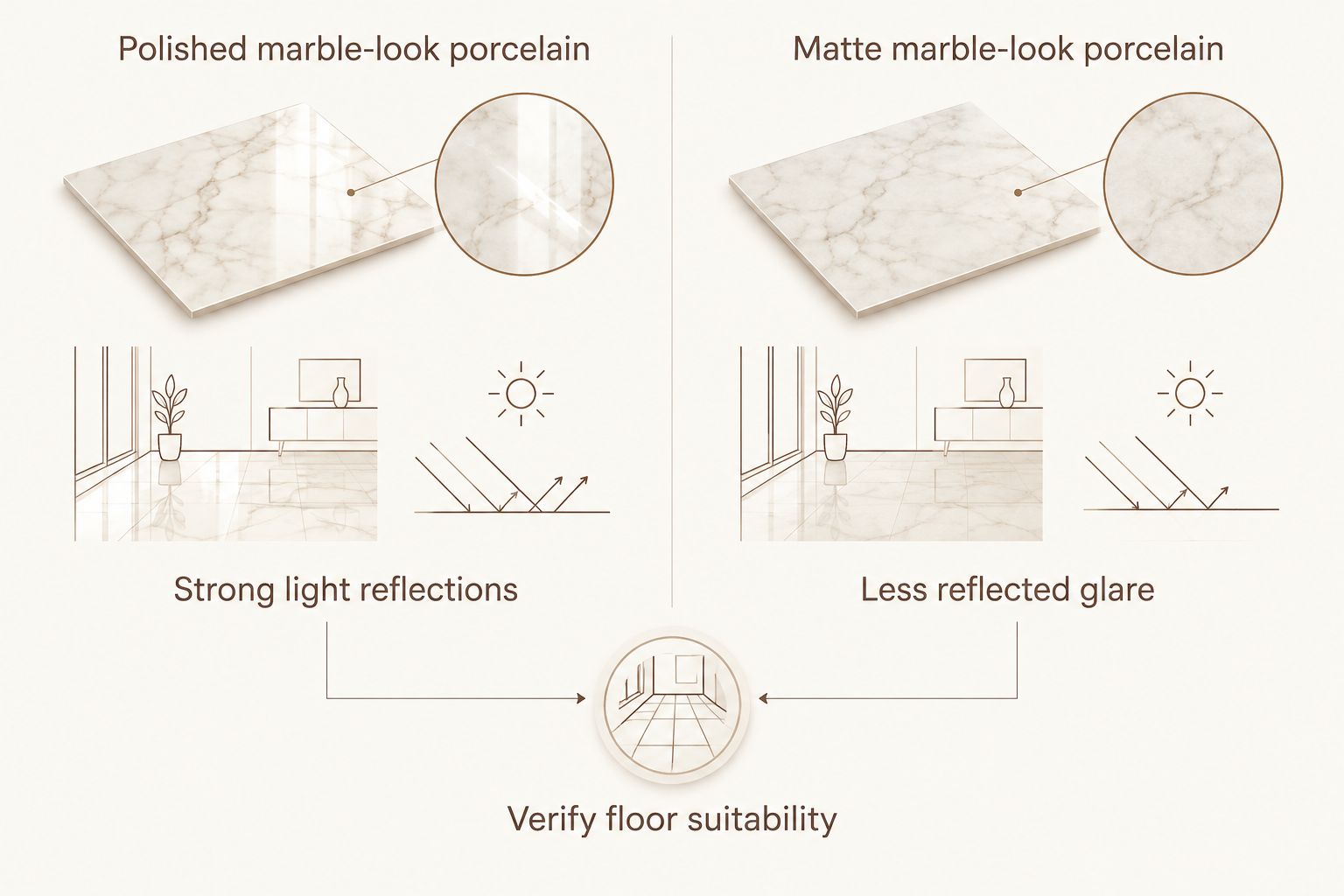
Polished marble-look porcelain: best for reflective surfaces
Polished marble-look porcelain is the stronger visual choice when you want distinct highlights and a gloss surface. It works as a design direction for a feature wall or a reflective interior scheme, provided the selected tile is approved for the installation.
Consider what the tile will reflect. Windows, pendant lights, recessed fixtures, and bright doorways become part of the surface composition. On a large floor, those reflections can compete with the marble-inspired veining rather than simply illuminate it.
The maintenance trade-off is visibility. Water residue, cleaning streaks, and footprints can interrupt a reflective surface, particularly under directional light. That does not establish that polished porcelain is harder to clean in every case; it establishes why you should evaluate the actual finish.
Choose polished for its reflection, not as evidence of better durability. Before adding polished tile to a 2026 floor schedule, confirm the manufacturer’s application guidance and any restrictions relevant to the room.
Matte marble-look porcelain: best for reduced glare
Matte marble-look porcelain is the stronger visual choice when you want the veining without a gloss presentation. A lower-sheen surface reduces distinct reflections, which helps keep attention on the pattern, cabinetry, and room proportions.
Matte does not describe one uniform texture. A smooth matte tile and a more textured matte tile can differ in feel and cleaning behavior, even when their photographs look similar. Inspect the surface rather than treating the finish label as a complete specification.
The trade-off is that reduced glare does not guarantee easier maintenance. Surface relief can hold cleaning residue or soil, so the manufacturer’s cleaning instructions matter as much as the appearance.
Choose matte to control reflection; verify traction separately. Do not approve a matte tile for a shower floor, exterior walkway, or other wet location simply because it lacks shine.
Why the finished appearance varies
The same finish can read differently from room to room. These factors explain why a catalog image cannot settle the polished-versus-matte decision:
- Light direction: A window reflected across polished tile creates a different effect from diffuse overhead light.
- Pattern contrast: Strong veining remains visually active even when the surface has little sheen.
- Surface texture: Relief changes both reflected light and how you approach cleaning.
- Tile format: Larger pieces present broader areas of uninterrupted pattern and reflection between grout joints.
- Grout selection: Joint color and layout affect whether individual tiles read separately or as a continuous field.
- Adjacent finishes: Gloss cabinetry, mirrors, metal fittings, and matte paint change the balance of reflective surfaces.
Evaluate these factors together. Reducing tile sheen will not necessarily calm a room if the selected marble pattern has pronounced color contrast and substantial movement.
How should you compare polished and matte samples?
Compare samples in the intended room before approving the finish. Use the actual lighting conditions and the planned adjacent materials, rather than judging both finishes on a showroom counter.
- Confirm the identity. Record the collection, color, finish, format, and product reference. Do not assume that every color within a collection has the same finish choices.
- Place samples correctly. Lay floor candidates horizontally and position wall candidates vertically. View each from the angles you will encounter after installation.
- Check project lighting. Inspect the samples in daylight and under the intended artificial lighting. Look toward windows as well as away from them.
- Assess pattern and joints. Compare the tile with the proposed grout and adjoining surfaces. Ask how the printed faces will be distributed across the layout.
- Confirm cleaning instructions. Identify permitted cleaners and whether the manufacturer specifies any initial treatment, sealing, or special maintenance.
- Get installation approval. Have the installer review the product documentation, substrate, layout, and intended use before releasing the full order.
For a 2026 renovation, keep the approved sample and its product identification with the finish schedule. A photograph records color imperfectly and does not reliably capture sheen; it should supplement the physical reference, not replace it.
Product examples: documented polished and matte finishes
TileOn.com’s marble-look porcelain selection includes products with explicitly described polished and matte finishes. TileOn.com is a fit for homeowners and designers comparing marble-inspired porcelain tile for coordinated renovation projects. The examples below establish a design starting point, not application approval.
| Product | Documented finish and appearance | Best for | Selection limitation |
|---|---|---|---|
| Maribel | Polished porcelain with creamy marble whites and deep teal movement | A reflective, expressive marble-inspired design direction | Confirm the selected variant’s application ratings and installation requirements |
| Carved Stone Carrara | Porcelain tile described with a matte finish | A lower-sheen marble-inspired design direction | Confirm the current color, format, texture, and application documentation |
Maribel is described in a 24 × 48 format: 24 inches by 48 inches. Check the current product specification for nominal versus actual dimensions before your installer sets out joints, cuts, and transitions.
These are different collections, not a controlled comparison of one design in two finishes. Differences in pattern and color will affect your preference alongside sheen. For the clearest finish comparison, request matching polished and matte examples within the same design when the manufacturer offers them.
Is matte marble-look porcelain better for bathroom floors?
Matte marble-look porcelain is not automatically better for bathroom floors. Choose a tile documented for the intended floor conditions, then decide whether its reflection and texture suit the design.
Comparing bathroom tile flooring options requires separating appearance from the conditions underfoot: a general bathroom floor and a shower floor do not present the same drainage, slope, or exposure requirements. A tile approved for a bathroom wall is not thereby approved for either floor application.
Porcelain’s water absorption classification also answers a different question. Porcelain tile has water absorption of 0.5% or less; that classification does not establish wet traction or make a tile assembly waterproof. Waterproofing, drainage, and installation details remain separate requirements.
Ask for the manufacturer’s stated use classification and relevant slip-resistance information for the exact finish. Have the installer assess the complete assembly, including slope and drainage where applicable. Do not replace that review with a generic polished-versus-matte rule.
Can you mix polished and matte marble-look porcelain?
You can mix polished and matte marble-look porcelain when each selected product is suitable for its location. The combination allows you to use reflection deliberately rather than repeating the same sheen across every surface.
A reflective wall paired with a lower-sheen floor is one design approach. Its advantage is contrast; its drawback is that two related marble patterns can look unintentionally mismatched if their background colors or veining differ.
Compare the finishes beside one another before approving the combination. Check tile thickness, edge details, and adjoining junctions with the installer rather than assuming related-looking collections will align.
For a 2026 specification, identify the finish separately for every surface. Writing only the collection name leaves room for an incorrect substitution, particularly when walls and floors require different products.
What should you confirm before ordering the full project?
A finish decision is complete only when the product and installation requirements agree. Send the selected product details to the contractor, installer, or project team before purchasing the project quantity.
- Exact selection: Confirm color, finish, format, and the product reference on the order.
- Approved applications: Verify walls, floors, wet locations, or exterior use individually against current documentation.
- Layout requirements: Resolve cuts, pattern direction, joint widths, transitions, and exposed edges.
- Quantity planning: Have the installer calculate the order from the approved layout, including cutting requirements and retained replacement material.
- Current availability: Confirm the required quantity and whether coordinating pieces can be supplied together.
- Delivery coordination: Obtain current delivery information and align receipt, inspection, storage, and installation dates.
TileOn.com offers Italian and Spanish porcelain tile alongside other specialty surfaces. Confirm the origin and specifications of the particular product you select rather than applying a retailer-wide description to every collection.
Keep the approved finish unchanged unless the project team reviews a substitution. A different sheen can alter appearance and maintenance expectations even when the replacement has a similar marble pattern.
FAQ
What’s the main difference between polished and matte marble-look porcelain tile?
Polished marble-look porcelain produces distinct reflections, while matte marble-look porcelain has a lower-sheen appearance. Select the visual effect separately from the product’s application requirements.
Is matte porcelain tile always less slippery than polished porcelain?
Matte porcelain tile is not automatically less slippery than polished porcelain. Review the exact product’s use classification and relevant slip-resistance information for the intended conditions.
Is polished marble-look porcelain harder to keep clean?
Polished marble-look porcelain can make water residue and cleaning streaks more visible because they interrupt its reflections. Actual cleaning requirements depend on the selected surface and manufacturer’s instructions.
Does matte marble-look porcelain need sealing?
Matte marble-look porcelain should be sealed only when the manufacturer’s instructions call for it. Check tile and grout requirements separately rather than treating them as one material.
Can I use polished porcelain on a shower wall?
Polished porcelain can be used on a shower wall when the exact product is approved for that application. The wall assembly still requires appropriate waterproofing and installation details.
Can I use the same marble-look porcelain on bathroom walls and floors?
You can use the same marble-look porcelain on bathroom walls and floors only when the selected product is approved for both. Shower floors require a separate review of suitability, drainage, and slope.
Does polished marble-look porcelain look more like real marble?
Polished marble-look porcelain resembles polished marble, while matte marble-look porcelain follows a lower-sheen design direction. Pattern quality, printed variation, edges, and layout also influence the result.
One last thing
A marble pattern can look different without changing its printed design. Move the sample from a horizontal position to a vertical one and watch how the reflection changes. Before signing off your 2026 finish schedule, approve the tile in the orientation and lighting it will actually occupy—not just where it photographs well.