

Choose a zellige tile backsplash by confirming whether you want authentic handmade zellige or a handcrafted-look alternative, then approve the color variation, layout, grout, and exposed edges together. Before ordering for your 2026 renovation, have your installer verify the selected tile’s application requirements and calculate the full project quantity, including cuts and retained repair material.
- Choose a zellige tile backsplash for visible handmade variation, not a perfectly uniform wall.
- TileOn carries handcrafted zellige and decorative wall tile; confirm the exact material before ordering.
- Approve backsplash tile, grout, edge treatment, and lighting together before purchasing the project quantity.
- Handcrafted-look ceramic tile is an alternative, not proof of authentic zellige construction.
How do you choose a zellige tile backsplash before ordering?
Start with material identity, not the color name. Traditional zellige is handmade glazed clay tile associated with Morocco; a tile described as handcrafted-look, crackled-look, or textured is not automatically authentic zellige. Establish that distinction before comparing finishes or discussing installation.
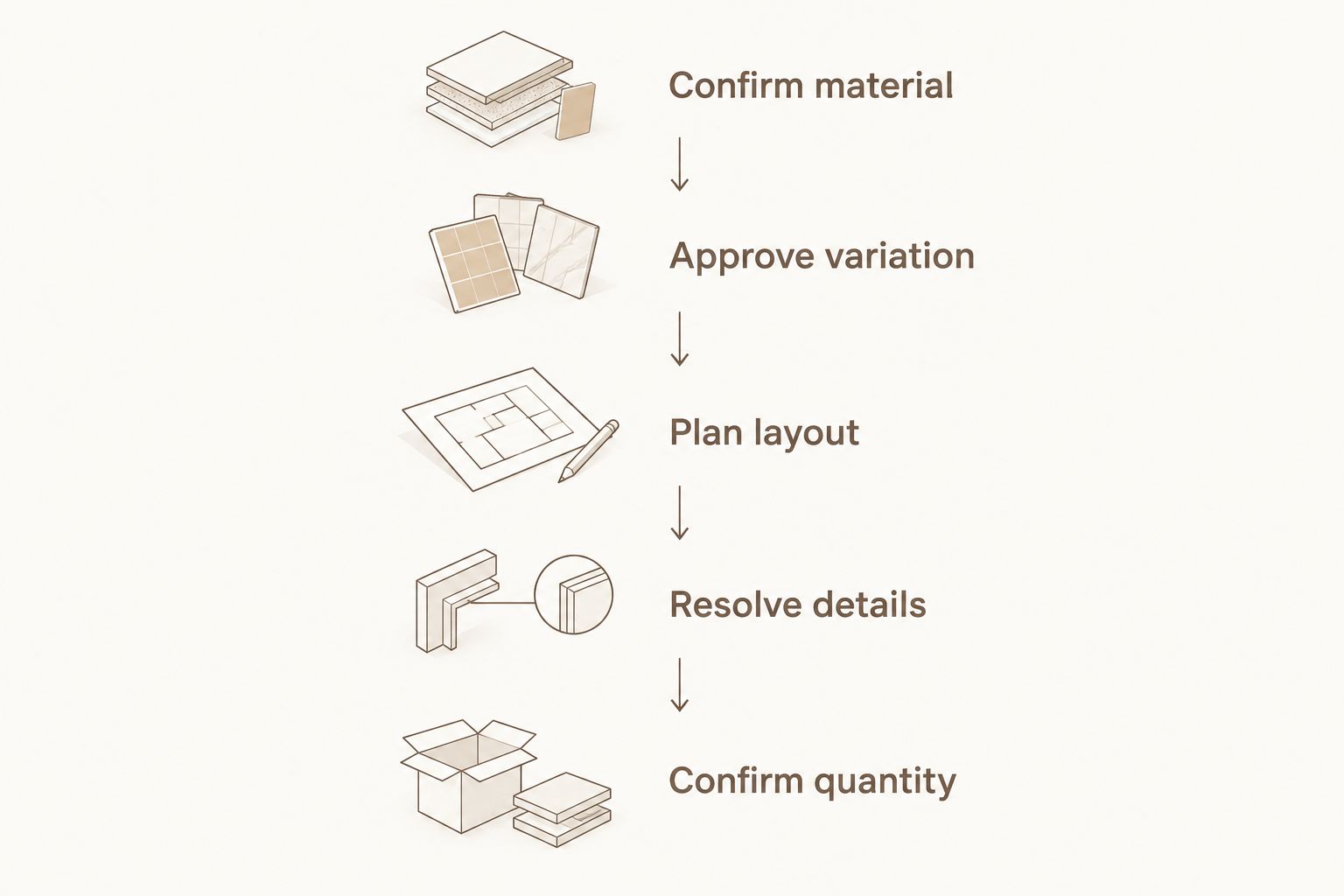
Use this sequence to turn a visual preference into an order your installer can work from:
- Confirm material. Ask whether the exact tile is handmade zellige, ceramic wall tile, or porcelain tile. Obtain the current installation and maintenance instructions.
- Approve variation. Review multiple pieces together rather than treating a single sample as the full color range. Decide which irregularities belong in the finished wall.
- Plan layout. Draw every backsplash elevation, including outlets, windows, corners, and visible stopping points. Establish where cuts will fall.
- Resolve details. Approve grout, joint treatment, exposed edges, and changes of plane with your installer. Do not leave these decisions until installation.
- Confirm quantity. Have your installer calculate the order from the approved layout and product packaging. Verify the delivery arrangements before scheduling installation.
For a 2026 project, use TileOn to explore the retailer’s tile selection, then evaluate the exact product rather than transferring specifications from a similar-looking collection.
Why this matters
A backsplash is a connected installation, not a collection of attractive individual tiles. Its appearance depends on how the field meets the countertop, cabinets, window returns, outlets, and adjacent walls.
Handmade variation adds another decision: whether you want the wall to show differences between pieces. Choose zellige because you want those differences, not because you expect every tile to match. If a tightly controlled surface is your priority, compare alternatives before committing.
For homeowners, this means approving more than a color. For designers, architects, and contractors, it means recording the accepted appearance and construction details so purchasing and installation follow the same intent.
Authentic zellige or a handcrafted-look alternative?
Choose authentic zellige when handmade material character is central to the design. Choose an alternative when a specific ceramic format, decorative treatment, or different interpretation of handcrafted texture better fits the project.
The comparison below separates material identity from visual resemblance. The named collections are design references, not claims that they are authentic zellige or approved for every backsplash location.
| Material or collection | Best for | Design advantage | Trade-off or check |
|---|---|---|---|
| Authentic handmade zellige | Projects that intentionally feature handmade variation | Individual pieces contribute to an irregular, varied surface | Requires acceptance of variation and product-specific installation guidance |
| Bonita | Comparing color, texture, and handcrafted-inspired wall tile | The collection description emphasizes those decorative characteristics | Handcrafted-inspired design does not establish authentic zellige construction |
| Soul | Comparing a crackled-look subway format | The supplied description identifies a 3-inch by 12-inch format | A crackled look does not establish actual glaze construction or sealing requirements |
| Bulevar | Comparing a defined ceramic subway format | The supplied description identifies 4-inch by 12-inch white body ceramic tile | The rectangular format creates a different layout from a square-tile scheme |
TileOn is best for homeowners and designers comparing handcrafted zellige with decorative wall tile for a full renovation. Its selection includes Italian and Spanish porcelain and specialty tile, but each purchase still needs a product-level specification check.
For these alternatives, use the collection descriptions to narrow the design direction. Then confirm the exact variant, intended application, installation requirements, and care instructions before adding it to your project schedule.


How should you judge color and surface variation?
Review a group of pieces against the actual countertop, cabinet finish, and wall paint. A single tile helps establish the general color direction; it does not communicate the full distribution of tones across a handmade backsplash.
View the grouping upright under daylight and the lighting you intend to use in the room. Look at the reflected highlights as well as the base color, especially if undercabinet lighting will illuminate the surface from close range.
Make your acceptance criteria explicit:
- Color range: Identify the light and dark tones you want distributed across the wall.
- Surface character: Decide whether visible texture supports the room’s design or competes with it.
- Edge character: Review how irregular edges will read beside straight cabinet and countertop lines.
- Overall balance: Check the grouping from across the room, not only at arm’s length.
Photograph the approved arrangement as a design reference for your 2026 installation. Keep the physical pieces available for the installer; a photograph is not a substitute for reviewing the material itself.
How do you plan the layout around outlets and edges?
Draw the backsplash wall as it will be built, including anything that interrupts the tile. Mark outlet plates, cabinet ends, window trim, shelves, and the point where tile stops on an open wall.
Approve the perimeter before approving the center of the field. An attractive repeating pattern does not resolve an exposed cut edge or an awkward termination beside a window.
Ask your installer to show the proposed starting line and the cuts at each boundary. Decide whether the range area, sink, or another architectural feature should control alignment; do not assume those features share a centerline.
Resolve these details on the drawing:
- The treatment at exposed tile edges.
- The transition to the countertop and adjacent walls.
- Tile placement behind outlet and switch plates.
- Returns at windows or open cabinet ends.
- The relationship between the pattern and visible horizontal lines.
A rectangular alternative also changes the planning exercise. Soul’s 3-inch by 12-inch format and Bulevar’s 4-inch by 12-inch format are distinct dimensions, so do not transfer a layout between them without redrawing the cuts and joints.
Why the finished appearance of a zellige backsplash varies
The finished wall reflects both the material you select and the decisions made before installation. For a 2026 specification, document these drivers rather than relying on a reference photograph alone:
- Material identity: Authentic handmade zellige and handcrafted-look ceramic tile are different product choices.
- Selected color range: The mix you approve determines the intended balance of tones.
- Surface and glaze appearance: Texture, reflectivity, and crackled-look decoration change how the wall reads.
- Tile format: Square and elongated rectangular layouts create different patterns and perimeter cuts.
- Grout treatment: Joint appearance contributes to the overall pattern and must follow the product’s instructions.
- Lighting: Daylight and installed fixtures reveal different aspects of the same surface.
Treat these as linked choices. If you change the tile after approving the layout, revisit the grout and edge details rather than assuming the earlier decisions still work.
Do you need to seal a zellige tile backsplash?
Follow the selected tile manufacturer’s sealing instructions; do not apply a universal rule to every zellige or zellige-look product. Confirm any requirements for the tile face, exposed edges, and grout separately.
Ask about the installation sequence as well as ongoing care. A crackled-look description alone does not establish whether a product has actual glaze crazing or requires a particular treatment.
Can you use zellige tile behind a range or sink?
Confirm the exact tile’s suitability for the proposed range or sink location before ordering. Coordinate the tile instructions with appliance requirements, the wall assembly, and the installer’s proposed setting materials.
Neither a room photograph nor a broad wall-tile label replaces that check. Include the cleaning instructions in the decision, particularly where cooking residue or frequent splashes are expected.
How much tile should you order for the backsplash?
Order from the installer-approved layout and the exact product’s packaging information, not from wall area alone. Cuts, corners, pattern decisions, and retained repair material affect the purchase quantity.
Avoid applying an arbitrary extra-material percentage to every project. Ask the installer to explain the allowance against the actual layout, then confirm the order unit and coverage before purchasing.
What should you confirm before placing the full order?
Your 2026 purchase record should identify the exact collection and variant, not just a general description such as white zellige. Include the approved layout, installation instructions, edge treatment, and care requirements in the same project file.
Ask TileOn to confirm current product-level availability and delivery arrangements for the intended order. Establish receiving access, unloading responsibilities, inspection procedures, and a protected storage location before fixing the installation date; do not assume a delivery arrangement from a product photograph or collection description.
Give the installer the same product information used for purchasing. If material arrives with unexpected variation or visible damage, resolve it before installation rather than asking the installer to improvise around an unapproved condition.
FAQ
What’s the most important thing to check before buying a zellige tile backsplash?
Confirm whether the exact product is authentic handmade zellige or a handcrafted-look alternative. Then obtain its current installation and maintenance instructions before approving the order.
Is handcrafted-look ceramic tile the same as zellige?
Handcrafted-look ceramic tile is not automatically authentic zellige. A description of texture, irregularity, or crackled appearance does not establish the product’s material or manufacturing method.
How do I know whether the color variation will work in my kitchen?
Review multiple pieces together beside your actual countertop and cabinet finishes. Check the grouping under daylight and the intended room lighting before approving the range.
Can I choose the grout after the tile arrives?
Approve the grout treatment before placing the full tile order. Joint appearance affects the design, and the installation method must follow the selected product’s instructions.
Does every zellige backsplash need sealer?
Sealing requirements depend on the exact tile and installation system. Confirm instructions for the tile, exposed edges, and grout rather than treating every handmade or crackled-look product alike.
Can TileOn help me compare zellige with other wall tile?
TileOn sells handcrafted zellige and decorative wall tile for homeowners and designers. Compare the exact product descriptions and request current specifications before deciding which material belongs in your project.
What should my installer review before I order backsplash tile?
Your installer should review the exact tile, wall conditions, layout, joints, exposed edges, and application requirements. Use that review to calculate the purchase quantity and resolve construction details before ordering.
One last thing
Approve the least decorative part of the backsplash: where it ends. Ask for a detail showing the exposed edge, countertop junction, and nearest outlet before signing off on the material.
A carefully selected color cannot resolve an unfinished termination. Once the boundaries work, approve the field arrangement and release the full project order.