

Compare porcelain slabs by documented application suitability, exact dimensions and thickness, surface finish, fabrication requirements, and the layout your installer can execute. Before ordering in 2026, confirm the full-slab appearance, cutting plan, access route, and current delivery arrangements; a finish sample alone cannot settle those decisions.
- Compare porcelain slabs by approved application and installation requirements before choosing appearance.
- Tileon.com suits homeowners and designers sourcing Italian and Spanish porcelain for renovation projects.
- Check full-slab imagery alongside samples; neither replaces a dimensioned cutting plan.
- Confirm current product specifications, quantities, stock availability, and delivery arrangements before authorizing an order.
Why this matters
The strongest slab choice is the one that meets your project's technical requirements and works in the approved layout. An attractive surface still needs a workable path from delivery to installation, with coordinated decisions about cuts, joints, edges, and support.
Tileon.com sells Italian and Spanish porcelain alongside specialty tile. When comparing that selection, keep the exact product listing attached to your project notes rather than relying on a saved image or a general material description.
For your 2026 renovation, establish the application first. A shower wall, floor, exterior surface, and countertop require different checks; do not transfer approval from one application to another.
How do you compare porcelain slabs before ordering?
Build a comparison sheet using the same fields for every candidate. Ask your supplier for current documentation and have the installer or fabricator review it before you approve the material.
| Comparison field | What to record | What must be resolved before ordering |
|---|---|---|
| Intended application | Exact surface and location | Written suitability for that application |
| Dimensions | Listed size and usable dimensions | Fit within the measured layout and cutting plan |
| Thickness | Exact product thickness | Compatibility with support, transitions, and edge details |
| Finish | Manufacturer's finish designation | Appearance, cleaning guidance, and application suitability |
| Pattern | Full-slab imagery and available face information | Vein direction, repetition, and joint placement |
| Fabrication | Required cuts, openings, and exposed edges | Fabricator acceptance of the specified material |
| Installation | Current product and installation instructions | Substrate, setting materials, joints, and handling method |
| Fulfillment | Order quantity and delivery requirements | Current stock confirmation, access, and receiving arrangements |
Do not treat a blank field as approval. Keep the candidate conditional until the responsible supplier, installer, or fabricator answers the question.
Start with the application
Write the intended use in specific terms: interior shower wall, kitchen backsplash, bathroom floor, or another defined surface. Include whether the installation encounters water, outdoor conditions, heat, or concentrated loads.
Ask whether the exact product—not merely the collection or material category—is approved for that use. Porcelain's material classification does not establish suitability for every installation, finish, or assembly.
Check dimensions against the actual layout
Compare slab dimensions with measured wall elevations or floor plans. Identify finished boundaries, corners, openings, and transitions before deciding how many pieces the project needs.
A larger format can reduce the number of field joints, but it also changes handling and cutting requirements. Confirm that the intended pieces can reach the installation area without an unresolved access problem.
Review thickness with the fabricator
Thickness affects the assembly, not just the appearance of the slab edge. Your installer needs to coordinate the material with the substrate, setting system, adjoining surfaces, and any exposed-edge treatment.
Do not assume that a thicker slab is automatically the better choice. Choose the thickness the documented application and installation details support.
How should you compare porcelain slab finishes?
Compare finish options under the lighting and use conditions of the intended room. Manufacturer terminology varies, so record the exact designation rather than simplifying every surface to polished or matte.
| Finish option | Best for | Advantage to assess | Limitation to assess |
|---|---|---|---|
| Polished | Projects seeking reflected light and a glossy appearance | How reflections interact with the room and pattern | Glare and suitability for the intended surface |
| Matte | Projects seeking a lower-gloss appearance | How the surface reads beside cabinetry and other finishes | Whether its particular texture meets cleaning and application needs |
| Textured | Projects seeking visible or tactile surface relief | How the texture contributes to the design | Cleaning access and any required performance documentation |
These are visual selection categories, not application approvals. A matte finish is not proof of slip resistance, and a textured appearance does not establish exterior suitability.
Review samples under 2 lighting conditions: daylight and the planned artificial light. This is a comparison procedure, not a performance test; use product documentation to resolve technical questions.
How do you compare pattern, faces, and slab orientation?
A sample helps you assess local color, gloss, and texture. Full-slab imagery shows information a small piece cannot: the scale of veining, large color changes, and the relationship between quiet and heavily patterned areas.
For a 2026 material schedule, retain both the sample reference and the current full-slab image. Ask what variation to expect and whether the imagery represents the supplied material, a design face, or a room rendering.
Review the cuts, not only the uncut slab
Place proposed cuts over the slab image when imagery and dimensions allow. Check where veins meet a corner, where an opening interrupts a feature, and whether adjacent pieces create an intentional composition.
If you want bookmatching or continuous-looking veining, confirm that the specific material and supplied faces support it. Do not infer either feature from a room photograph.

Ask your designer or installer to mark the preferred orientation on the layout. A verbal instruction such as keeping veins vertical is less useful than an elevation showing the direction at each surface.
Why do porcelain slab requirements vary by project?
The product comparison changes when the installation changes. Use these factors to explain differences between candidates without assuming that one specification is universally better:
- Application: Walls, floors, and other surfaces need their own suitability checks.
- Dimensions: The room geometry determines which sizes create workable cuts and joint locations.
- Thickness: Support, transitions, and edge details must coordinate with the specified material.
- Finish: Lighting, cleaning expectations, and documented surface performance affect the decision.
- Layout: Openings, corners, and pattern direction determine how pieces fit together.
- Delivery: Site access and receiving arrangements affect how material reaches the work area.
Stock availability is also a buying consideration. Confirm it for the exact product and quantity when you are ready to order; do not build the installation schedule around an unverified assumption.
What should your installer approve before you order?
Assemble 3 documents: the current product specification, a dimensioned layout, and the installation requirements. Give the same set to the supplier, designer, and installer so each person reviews the same proposed assembly.
For a 2026 project file, record the date each document was received. If the selected product, finish, or thickness changes, request a fresh review rather than carrying approval across automatically.
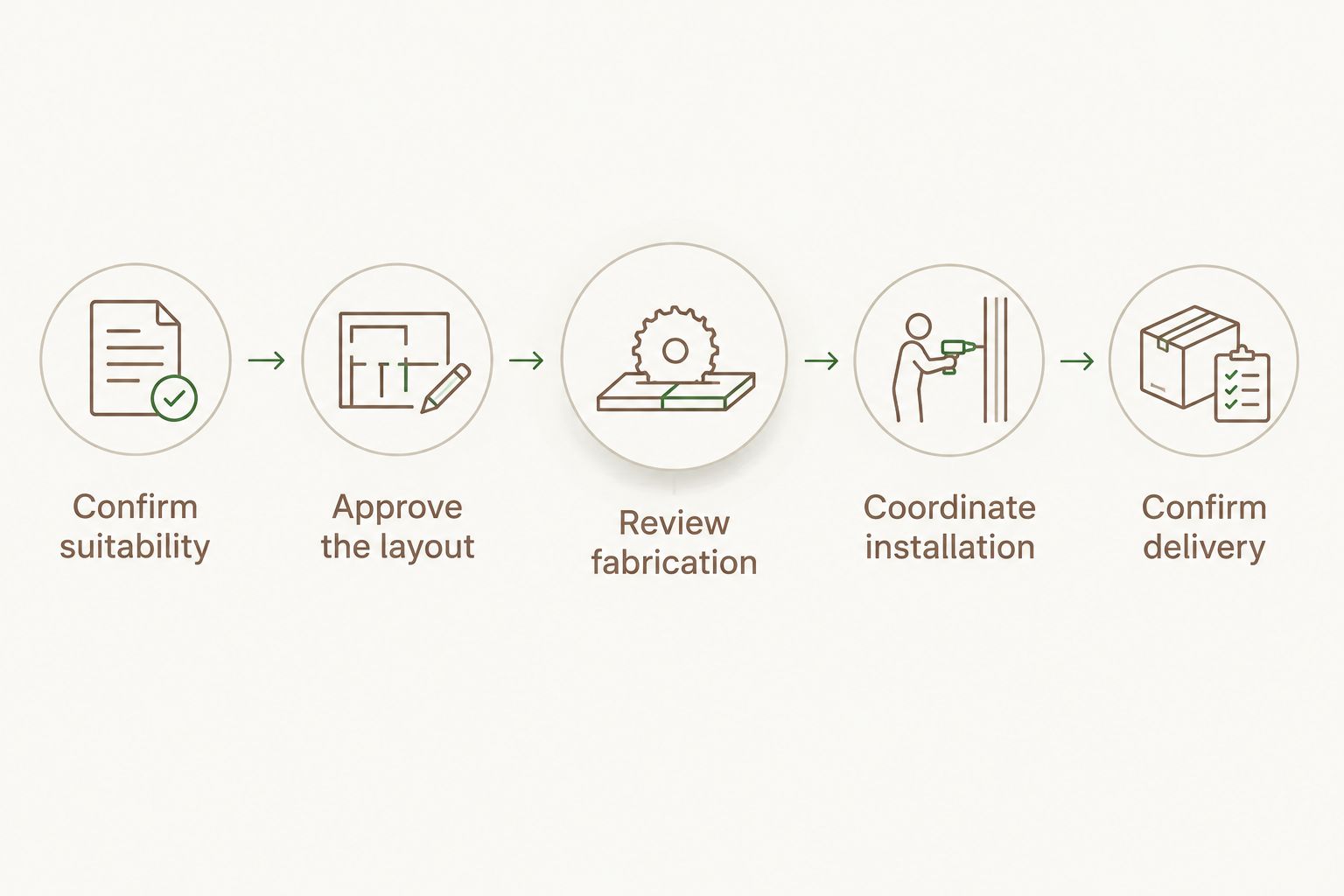
- Confirm suitability. Identify the exact application and obtain the relevant product documentation.
- Approve the layout. Mark joints, corners, openings, vein direction, and finished boundaries.
- Review fabrication. Have the fabricator confirm cuts, penetrations, edge treatment, and handling requirements.
- Coordinate installation. Resolve substrate preparation, setting materials, movement accommodation, and adjoining finishes.
- Confirm delivery. Agree on access, unloading responsibilities, inspection, and temporary storage before dispatch.
Resolve fabrication questions before ordering, not after material reaches the site. Openings and exposed edges need a defined detail, and the installer must accept the material and installation approach rather than simply agree to its appearance.
Is a sample enough to approve porcelain slabs?
A sample is enough to assess a small area of color, texture, and finish, but not the complete slab layout. Combine it with full-slab imagery, current specifications, and a dimensioned cutting plan before final approval.
Use the sample beside the actual cabinetry, metal finishes, and adjoining surfaces. Keep the approved reference identifiable so the designer, homeowner, and contractor are discussing the same selection.
Does a larger porcelain slab always mean fewer problems?
A larger porcelain slab does not automatically produce a better installation. It can reduce field joints in a suitable layout, but its dimensions also affect transport, handling, cutting, and access.
Compare the finished composition rather than the slab size alone. A well-positioned joint is preferable to a layout that depends on an unresolved delivery route or fabrication detail.
How do you turn the shortlist into an order-ready specification?
Create 1 approved material schedule that identifies the exact product, finish, thickness, quantity, and application. Attach the approved layout and list any questions that still require written confirmation.
Use the listing's actual name, such as Kingdom Lux, rather than a nickname in your correspondence. A product name identifies the candidate; it does not establish its dimensions, composition, or suitability without supporting specifications.
Tileon.com is best for homeowners and designers sourcing Italian and Spanish porcelain for renovation projects. Its porcelain slab selection still requires the same product-specific checks as any other source: confirm specifications, fabrication acceptance, and fulfillment arrangements before committing.
The benefit of selecting online is that you can organize product references for the whole project. The limitation is that a screen image cannot resolve tactile finish, full-scale pattern placement, or site-specific installation questions.
Confirm quantity and receiving details
Have the installer or fabricator calculate quantity from the approved cutting plan, including material needed for the agreed layout and fabrication approach. Do not apply an unexplained allowance without checking what it covers.
Before releasing a 2026 order, confirm current stock availability, delivery arrangements, site access, and the receiving inspection procedure. Ask how damage or a discrepancy must be documented and reported; follow the supplier's actual terms rather than assuming a policy.
FAQ
What should I compare first when choosing porcelain slabs?
Compare documented suitability for the intended application first. Then review dimensions, thickness, finish, fabrication requirements, and the proposed layout for the exact product.
Are thicker porcelain slabs always better?
Thicker porcelain slabs are not automatically better for every project. Select thickness according to the approved application, support requirements, edge details, and adjoining surfaces.
Can I approve porcelain slabs from a sample alone?
A sample alone cannot approve the full-slab appearance or cutting layout. Use it for local color and texture, then review full-slab imagery and a dimensioned plan.
Is matte porcelain automatically suitable for a shower floor?
A matte finish does not establish shower-floor suitability. Check the exact product's approved uses and relevant performance documentation, and have the installer review the complete assembly.
Do porcelain slabs need a layout before ordering?
Porcelain slabs need a coordinated layout before you finalize quantities and fabrication. Mark joints, openings, corners, and pattern direction so the order reflects the intended installation.
What should I confirm about delivery before ordering slabs?
Confirm current stock availability, delivery arrangements, access, unloading responsibilities, and receiving inspection procedures. Make sure the people receiving the material understand the agreed process.
What should I request when comparing Tileon.com porcelain slabs?
Request current specifications and the information needed to confirm the exact product's finish, dimensions, thickness, and application suitability. Have your installer or fabricator review those details alongside the project layout.
One last thing
Approve the cut piece, not just the slab photograph. A vein you like in the full image can fall outside the finished section or disappear into an opening; review the proposed cuts before treating the pattern as settled.