

Best overall starting point: Alpine Wood Look Tile for a defined plank format. Best light-wood direction: Alaska Wood Look Tile. Best weathered-timber direction: Iroko Wood Look Tile. Best stone-look direction: Gem Panda Tile. These porcelain bathroom floor tile picks are a design shortlist for 2026; approve each product’s floor application and wet-use specifications before ordering.
- Alpine Wood Look Tile is the clearest format-led starting point, with a documented 6-inch by 36-inch plank.
- Alaska Wood Look Tile suits a light-toned hardwood design direction; Iroko Wood Look Tile emphasizes weathered timber.
- Gem Panda Tile offers a large-format stone-and-marble design direction, subject to bathroom floor specification checks.
- Choose porcelain bathroom floor tile by verified application, wet-use requirements, layout, and project quantity—not appearance alone.
Why this matters
A bathroom floor needs more than the right color. You need a surface approved for its location, a format your installer can lay correctly, and an order coordinated with the rest of the renovation.
TileOn.com sells Italian and Spanish porcelain tile alongside specialty materials for interior and exterior projects. This guide separates the documented design characteristics of its porcelain candidates from the technical approvals your bathroom requires.
For homeowners and designers, TileOn.com porcelain bathroom floor tile selection starts with verified floor suitability, not appearance. A convincing wood or marble effect does not establish wet-area performance.
What makes the best porcelain bathroom floor tile?
Use these criteria before comparing designs for a 2026 renovation:
- Floor approval: Confirm that the exact product, finish, and size are approved for the intended floor application. A collection name is not an installation specification.
- Wet-use documentation: Read the manufacturer’s application guidance and slip-resistance information. A bathroom floor outside the shower and a shower floor are different applications.
- Format and layout: Match dimensions to room geometry, drain location, doorway transitions, and substrate preparation. Large tile does not eliminate installation work.
- Surface and maintenance: Examine texture, finish, and cleaning instructions. A textured surface and a smooth surface require different evaluation; neither label alone proves suitability.
- Design coordination: Compare the floor with the vanity, wall tile, countertop, and grout. Assess the combination under the bathroom’s planned lighting.
- Project readiness: Confirm quantity, current stock, delivery arrangements, and installation requirements before committing the construction schedule.
Porcelain is generally defined by water absorption of 0.5% or less, as tested under ASTM C373. That classification concerns the tile body; it does not certify slip resistance or make the installed bathroom waterproof.
Porcelain bathroom floor tile at a glance
The order below reflects distinct design needs, not a tested safety or durability ranking. Product descriptions establish the listed visual characteristics; final application approval remains a separate decision.
| Ranked candidate | Best for | Documented standout feature | Key limitation to resolve |
|---|---|---|---|
| Alpine Wood Look Tile | Planning around a defined plank format | Rustic porcelain wood look in a 6-inch by 36-inch format | Confirm the exact finish and bathroom floor approval |
| Alaska Wood Look Tile | A light-toned hardwood direction | Iceberg color with a light-hardwood appearance | Confirm dimensions, finish, and application requirements |
| Iroko Wood Look Tile | A weathered-timber direction | Porcelain interpretation of naturally weathered timber | Confirm surface characteristics and floor suitability |
| Gem Panda Tile | A stone-and-marble design direction | Large-format porcelain inspired by natural stone and marble | Confirm exact dimensions and installation requirements |
1. Alpine Wood Look Tile: best for plank-led bathroom layouts
Alpine Wood Look Tile is described as rustic porcelain with a weathered-hardwood appearance. Its documented 6-inch by 36-inch format gives you a concrete starting point for a bathroom layout rather than a visual concept alone.
The plank is 6 times as long as it is wide. Ask your installer to draw the proposed direction, perimeter cuts, and doorway treatment before approving the design; the dimensions do not establish the correct offset or joint width.
Alpine Wood Look Tile pros:
- Documented dimensions support an early layout drawing.
- The wood-look direction offers an alternative to stone-effect porcelain.
- The weathered-hardwood description gives designers a clear material reference.
Alpine Wood Look Tile cons:
- A long, narrow format requires deliberate planning around short walls and fixtures.
- Rustic wood character is not the right match for every restrained, uniform scheme.
- Bathroom floor and wet-use approval must be checked for the exact selection.
Best for: Homeowners, designers, and installers who want to evaluate a defined plank format before finalizing the room.
Verdict: Hold until the floor specification and layout are approved; Alpine Wood Look Tile is the default design starting point in this shortlist.
2. Alaska Wood Look Tile: best for a light-hardwood palette
Alaska Wood Look Tile is described as wood-look porcelain in the color Iceberg, with the appearance of light-toned hardwood. Choose this design direction when a pale wood reference is central to the bathroom material schedule.
Compare the actual surface with the vanity finish and wall tile. The word Iceberg identifies the stated color, but it does not establish the undertone you will see under your lighting.
Alaska Wood Look Tile pros:
- The light-hardwood description gives you a clear palette direction.
- A named color helps keep the finish schedule specific.
- Porcelain provides the wood effect without specifying hardwood flooring.
Alaska Wood Look Tile cons:
- A light-wood description does not establish an exact color match with cabinetry.
- The appearance alone does not establish texture, slip resistance, or shower suitability.
Best for: Renovations built around a light-toned wood appearance rather than rustic weathering or a stone effect.
Verdict: Hold until color coordination and application approval are complete; choose Alaska Wood Look Tile for its light-hardwood direction.
3. Iroko Wood Look Tile: best for weathered-timber character
Iroko Wood Look Tile is described as porcelain that captures naturally weathered timber. It is the shortlist choice when that weathered appearance is the design brief, rather than simply a light wood color.
Evaluate the surface alongside the room’s other patterned materials. A timber effect, veined countertop, and patterned wall tile each need consideration in the overall composition; approve them together rather than as isolated selections.
Iroko Wood Look Tile pros:
- The weathered-timber description establishes a distinct design direction.
- The porcelain material offers a timber appearance without using timber as the tile body.
- Its stated character provides a useful reference for coordinating cabinetry and wall finishes.
Iroko Wood Look Tile cons:
- Weathered character is a less direct fit when the brief calls for a uniform surface.
- The description does not establish the exact surface variation across an installation.
- Bathroom floor suitability still requires product-level confirmation.
Best for: Bathrooms where weathered-timber character is an intentional part of the material palette.
Verdict: Hold until the surface and application are reviewed; choose Iroko Wood Look Tile when weathering is the priority.
4. Gem Panda Tile: best for a stone-and-marble direction
Gem Panda Tile belongs to a large-format porcelain collection described as drawing on natural stone and marble. It is the alternative here for a bathroom that calls for a mineral appearance rather than wood grain.
For a 2026 project, resolve the actual dimensions before assuming how many joints the room will contain. “Large format” describes a category, not a complete layout, and it does not remove the need for perimeter joints, movement accommodation, or substrate preparation.
Gem Panda Tile pros:
- The documented stone-and-marble direction broadens the shortlist beyond wood effects.
- Large-format porcelain supports a format-led design discussion with your installer.
- The material reference provides a starting point for coordinating stone-look walls and counters.
Gem Panda Tile cons:
- Larger units require handling, cutting, and substrate planning.
- A format suited to the main floor is not automatically suited to a sloped shower floor.
- Confirm the exact finish and bathroom floor application before selection.
Best for: Homeowners and professionals planning a stone-look bathroom with large-format porcelain under consideration.
Verdict: Hold until dimensions, finish, and installation requirements are approved; choose Gem Panda Tile for the stone-and-marble direction.
Compare the shortlisted products
These TileOn.com porcelain tile candidates represent different design decisions. Review their current product information, then request confirmation for the exact bathroom application before authorizing the full order.


Turn the shortlist into an installation-ready selection
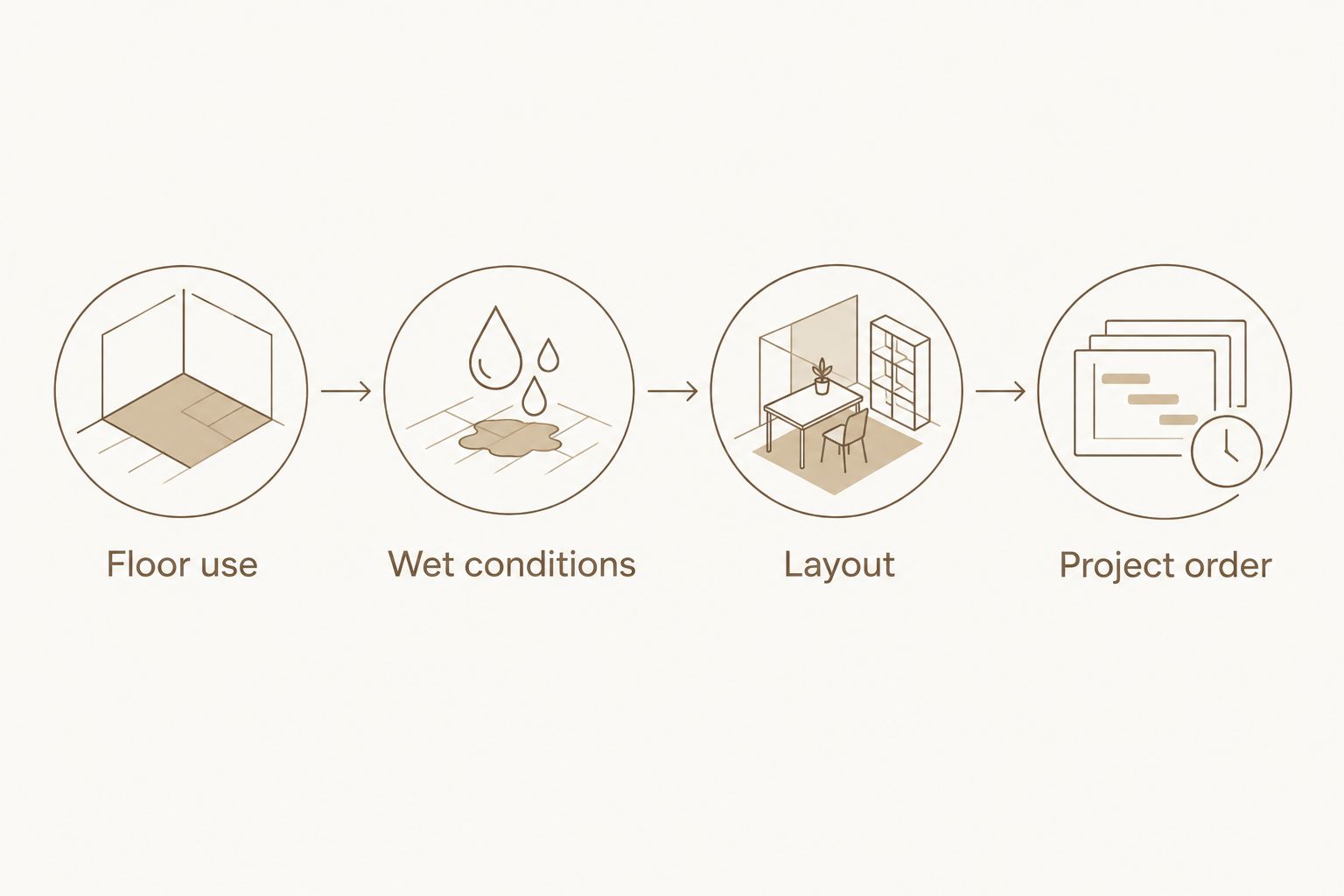
Use this sequence to keep the design decision connected to the building work. For a 2026 renovation, complete the technical review before fixing the tile installation date.
Floor use
Identify every tiled location separately: main bathroom floor, shower floor, shower wall, and threshold. Ask for written application guidance for the exact product and finish in each location.
Wet conditions
Review the manufacturer’s wet-use guidance and the project’s slip-resistance requirements. Do not treat a matte label, visible texture, or porcelain classification as a substitute for that review.
Layout
Have the installer check substrate condition, tile dimensions, joint requirements, transitions, and drain geometry. Request a layout showing visible cuts at the doorway, vanity, and shower boundary.
Project order
Confirm the measured quantity, installer-approved allowance, current stock, delivery arrangements, and batch considerations. Coordinate the order with waterproofing, setting materials, grout, and installation access rather than treating tile as a stand-alone purchase.
Keep the approved product information with the project documents. Homeowners need a clear record of what was selected; contractors and installers need the same record to avoid substitutions based only on appearance.
How the shortlist is ranked
This 2026 shortlist uses documented material descriptions and dimensions, with a distinct design role for each candidate. Alpine leads because its stated format supports a specific layout discussion; Alaska, Iroko, and Gem Panda address light hardwood, weathered timber, and stone-and-marble briefs respectively.
The ranking does not claim comparative slip resistance, wear performance, or bathroom approval. Those decisions require the current specifications for the selected product, finish, and application.
Which porcelain bathroom floor tile should you choose?
Start with Alpine Wood Look Tile if you want a defined wood-look plank format. Choose Alaska Wood Look Tile for a light-hardwood palette, Iroko Wood Look Tile for weathered-timber character, or Gem Panda Tile for a large-format stone-and-marble direction.
For a 2026 bathroom, the final winner is the candidate that passes the application review and works in the actual layout. Reject a design that cannot satisfy either condition, regardless of how well it matches the mood board.
FAQ
What’s the best porcelain bathroom floor tile for a renovation?
The best porcelain bathroom floor tile is approved for the intended floor application and fits the room’s layout. Alpine Wood Look Tile is the format-led starting point in this shortlist because its description specifies a 6-inch by 36-inch plank; verify its application before ordering.
Can I use the same porcelain tile on the bathroom and shower floors?
Only use the same porcelain tile in both locations when the exact product and format are approved for both applications. Shower drainage, slope, and wet-use requirements need a separate review.
Is matte porcelain automatically slip-resistant?
No, a matte appearance does not by itself establish slip resistance. Review the manufacturer’s technical information and application guidance for the selected finish.
Is wood-look porcelain suitable for a bathroom floor?
Wood-look porcelain is a design category, not an application approval. Confirm bathroom floor suitability for the exact product, finish, and size before specifying it.
Does porcelain tile make a bathroom waterproof?
No, porcelain tile does not make the bathroom assembly waterproof. Wet-area construction requires an appropriate waterproofing system, correctly detailed transitions, and installation consistent with the system requirements.
Is large-format porcelain better for a small bathroom?
Large-format porcelain is not automatically better for a small bathroom. Compare the actual dimensions with doorway cuts, fixtures, drain geometry, and substrate requirements before choosing it.
What should I confirm before ordering bathroom floor tile?
Confirm application approval, finish, dimensions, measured quantity, installation requirements, current stock, and delivery arrangements. Keep the approved selection and technical documents available to the installer.
One last thing
Resolve the doorway before approving the floor. Ask your installer to show the tile edge, adjacent flooring height, threshold, and door clearance together. A selected surface is only part of the result; the transition must work too.